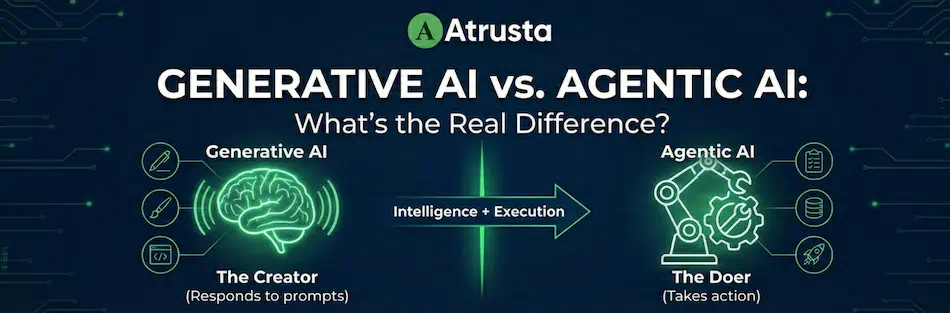
Not all AI works the same way. In practical systems, there is a big difference between AI that generates content on demand and AI that can plan, decide, and act across tools.
This article breaks down Generative AI and Agentic AI in plain language, with examples of when to use each and why the most powerful setups combine both.
Generative AI: The Creator
Generative AI takes a prompt and responds with text, code, images, or other content. It is great at creation, explanation, and ideation, but it waits for instructions before it does anything.
What Generative AI is good at
- Writing emails, blogs, and marketing copy.
- Summarizing long documents or meetings.
- Answering questions in chatbots or support flows.
- Suggesting code snippets or refactors.
It produces high‑quality content on request, but it does not chase your goals on its own or decide what to do next.
Agentic AI: The Doer
Agentic AI goes a step further. Instead of only responding to prompts, it can understand a goal, plan steps, call tools or APIs, and take actions until that goal is reached.
What Agentic AI is good at
- Running workflows end‑to‑end, such as booking travel or setting up campaigns.
- Orchestrating multiple tools: CRMs, calendars, email platforms, and internal APIs.
- Monitoring conditions and triggering actions automatically.
- Coordinating human approvals when needed, then continuing the process.
It can read data, decide what to do, use your systems, and report back on progress without constant supervision.
A Simple Side‑by‑Side View
| Capability | Generative AI | Agentic AI |
|---|---|---|
| Responds to prompts | Yes | Yes |
| Creates new content | Yes | Yes |
| Understands long‑term goals | Limited | Strong |
| Can take actions in tools | Only when manually integrated | Core capability |
| Works autonomously over time | No | Yes |
| Best mental model | On‑demand creator | Always‑on operator |
The Real Power: Using Both
In real products, the most useful systems pair Generative AI with Agentic AI. Generative AI handles the content and conversations, while Agentic AI turns decisions into actions.
Example: Marketing workflow
- Agentic AI plans a 4‑week campaign linked to your product launch.
- Generative AI drafts emails, ads, and social posts for each step.
- Agentic AI schedules sends, monitors performance, and optimizes based on results.
Example: Support workflow
- Generative AI chats with customers and drafts replies.
- Agentic AI checks accounts, updates tickets, and escalates edge cases to humans.
When To Use Which
Use Generative AI when you need
- Content creation: emails, posts, internal docs, and knowledge base articles.
- Ideas and explanations: brainstorming, outlines, and first drafts.
- Interactive Q&A: chatbots, copilots, and in‑app helpers.
Use Agentic AI when you need
- Automation: multi‑step processes that touch several tools.
- End‑to‑end workflows: onboarding, renewals, approvals, reporting.
- Systems that operate with minimal supervision and hand off only exceptions.
Final Thought
Generative AI changes how teams create. Agentic AI changes how work gets done.
The next wave of AI in businesses will not be just smarter chatbots, but systems where creators and doers work together: Generative AI to communicate and Agentic AI to execute.