Beyond Vector Databases: Why PageIndex Is a Superior Retrieval Architecture for Production AI

Blog
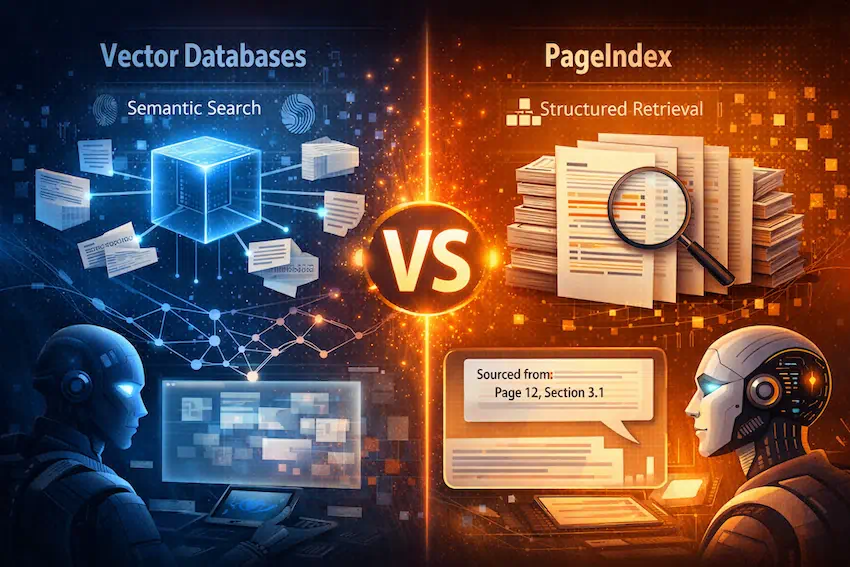
Illustration comparing vector databases using semantic search with PageIndex using structured, page-based retrieval for AI systems.

PageIndex vs. Vector Databases

Why PageIndex Is a Superior Retrieval Architecture for Production AI

Vector databases have become the default retrieval layer for many Generative AI systems. They promise semantic understanding, flexible search, and fast prototyping. As a result, they are often treated as a mandatory component of modern AI stacks.

But as AI systems move from demos to mission-critical production workloads, a different reality emerges:

Semantic similarity alone is not enough.

For accuracy-driven, enterprise-grade AI applications, PageIndex-based retrieval offers a more reliable, explainable, and scalable foundation than vector databases.

The Core Problem with Vector Databases

Vector databases retrieve information based on numerical similarity in embedding space. While this works well for exploratory search, it introduces fundamental weaknesses when precision matters.

Vector-Based Retrieval Architecture
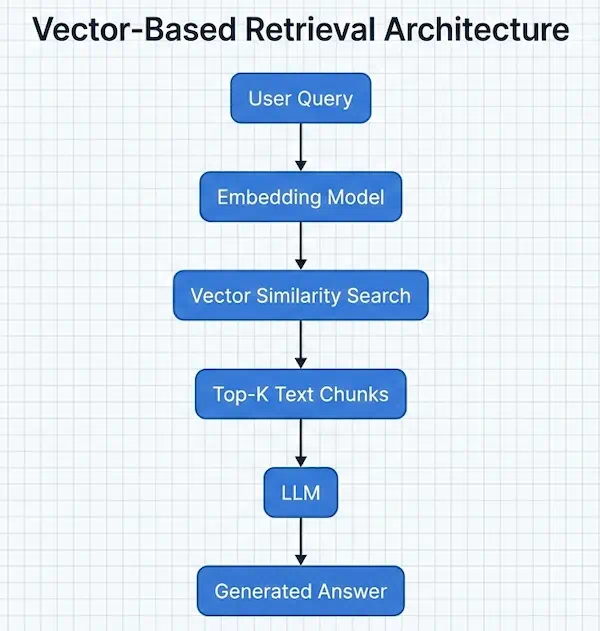
 

vector. based retrival architectire

This architecture assumes that:

  • Similar content is relevant content

  • Fragmented text chunks are sufficient context

  • Probabilistic retrieval is acceptable

In production systems, these assumptions frequently break.


Common Failure Modes of Vector Databases

1. Similar ≠ Correct

Vector search returns content that sounds related, not content that is authoritative or complete. This leads to:

  • Subtle factual errors

  • Omitted exceptions

  • Confident hallucinations

 
2. Context Fragmentation

Documents are split into arbitrary chunks to fit embedding limits.


Original Page
├── Definition
├── Table
├── Exception
└── Footnote

Chunked into


Chunk A: Definition (partial)
Chunk B: Table rows
Chunk C: Exception (missing footnote)

The LLM never sees the full picture.

 
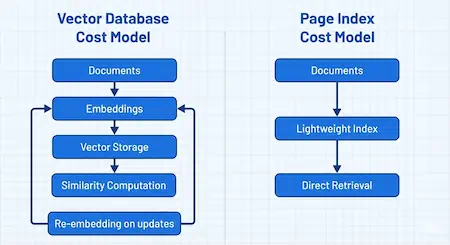
3. High and Unpredictable Cost

Vector systems require:

  • Continuous embedding generation

  • Memory-heavy vector storage

  • Re-indexing when data changes

Costs increase rapidly as data grows.


4. Poor Explainability

When an answer is wrong, it’s difficult to explain:

  • Why a chunk was retrieved

  • Why another chunk was ignored

  • What the true source of truth was

This is a major blocker for enterprise adoption.


Introducing PageIndex: Retrieval Built for Accuracy

PageIndex takes a fundamentally different approach.

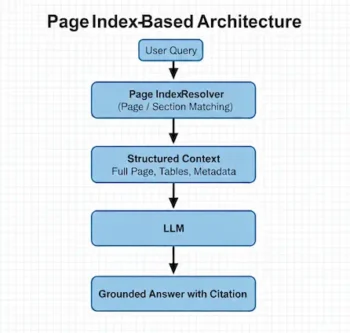
Instead of embedding fragments of text into vector space, PageIndex organizes knowledge around pages, sections, and document structure—the same way humans consume and reason about information.

PageIndex-Based Architecture

Page Index based Architectire

This approach prioritizes correctness, completeness, and traceability over fuzzy similarity.


Why PageIndex Outperforms Vector Databases

1. Deterministic Retrieval

PageIndex returns known, relevant sources, not “close matches.”

This is critical for:

  • Policies and compliance documents

  • Financial and expense data

  • Contracts and legal text

  • Enterprise knowledge bases

Production AI needs certainty, not probability.


2. Full Context Preservation

PageIndex keeps content intact:

  • Page boundaries

  • Headings and hierarchy

  • Tables and structured data

  • Footnotes and references

The LLM receives complete context, dramatically reducing hallucinations.


3. Lower Cost, Higher Performance

PageIndex avoids embedding churn and delivers:

  • Faster response times

  • Predictable infrastructure costs

  • Easier scaling for SaaS platforms


4. Built-In Explainability

With PageIndex, every answer can be traced to:

  • A specific page

  • A specific section

  • A specific document version

Example:

“Answer sourced from Page 18, Section 4.1 of Expense Policy v3.2”

This level of transparency is non-negotiable for enterprise AI.


5. Alignment with Human Reasoning

Humans think in:

  • Pages

  • Documents

  • Sections

  • Rules and exceptions

PageIndex mirrors this mental model, producing AI responses that are:

  • Easier to verify

  • Easier to trust

  • Easier to act on

Vector databases optimize for machine similarity.
PageIndex optimizes for human decision-making.


When Vector Databases Still Have a Role

Vector databases are not obsolete. They remain useful for:

  • Exploratory discovery

  • Recommendation engines

  • Creative ideation

  • Fuzzy search across unstructured content

However, they work best as a secondary enhancement, not the primary source of truth.


The Emerging Best Practice: Structure First

The AI industry is converging on a key insight:

Retrieval quality matters more than model size.

PageIndex represents a shift toward:

  • Structured retrieval before generation

  • Deterministic grounding before creativity

  • Trust before scale


Conclusion

Vector databases accelerated early GenAI experimentation, but they struggle under the demands of real-world production systems.

PageIndex offers a more accurate, explainable, and cost-effective retrieval architecture, making it better suited for enterprise AI, compliance-heavy domains, and scalable SaaS platforms.

As AI systems mature, architectures built on structure, context, and trust will win.

Tags :
AI Architecture,AI Retrieval,Enterprise AI,generative ai,PageIndex,Post-Vector AI,RAG,Structured Retrieval,Trustworthy AI,Vector Databases
Share This :

Leave a Reply

Your email address will not be published. Required fields are marked *